Language switching

Showing posts with label cousins. Show all posts

Monday, November 20, 2017

2017 Goal 2.2 - half of my 7th great grandparents on paternal grandfather's side identified

So 2017 is running to an end and I have barely blogged. As I explained, it was largely due to my 3rd kid and first son being born and generally time being at a premium.

So how did I fare against my goals?
Well I can report at least one success. The research of my paternal grandfather, Emil Krchak.

The goal was to identify half of my 7th great grandparents on Emil's side of the family.
And here is where I am (number of identified Emil's ancestors, generation per line):
While I am already missing two 4th great grandparents, I managed to hit the coveted 64 7th great grandparents. Unfortunately after that, the amount on known ancestors totally plummets...

Why?
[- Forget indices. Obvious, but always a tough one.]
- It is hard to keep fighting the ever increasing number of ancestors.
- The older materials are harder to work with. No parent information even on marriage records, no house numbers, no surnames for wives...
- The instability of surnames. Unfortunately, it seems the surnames are not completely stable any longer around the 17th to 18th century transition.
- There are several surnames, that cover significant portion of a village.
- The deeper we go, the more locations we need to cover, and any move is very hard to track...

Note: these are all Hornacko parish records on actapublica, i.e. Velka nad Velickou [then "Velka"] parish pre-tolerance.

So what do I do to combat the problems above?


  1. I maintain a list of all relevant surnames, and try to memorize it well.
    It is just not feasible to go through the same parish book over and over again, with one of few surnames in mind. Going through it once, or few times, with many surnames in mind is more time efficient.
    So how many? I try to cover all known 7th great grandparent surnames. They start to repeat, so this makes it around 38 surnames currently (some unknown, some repeated, some known to be in a different parish).
  2. I maintain a pen&paper ancestral index at hand.
    Having a quick reference of my ancestors, with all relevant where & when is indispensable tool.
  3. Note down every detail.
    Only by diligent research of every bearer of the surname in the parish can you distinguish the many occurrences of multiple pairs with the same name of husband & wife. Without house numbers, you need to use the indirect information - names of godfathers, alignment of children being born with mother's death.
    Similarly, only this can help you connect your multiple time widowed ancestor wedding information as being about the same person.
  4. Patience.
    It takes time. If you are not willing to pull 5 hours of work without obtaining a single new bit of information about your actual ancestors, this approach is not for you.
  5. Work on the weddings first.
    It is best to establish the known pairs who made it too adulthood, than decorate them with children. And only at last, fill in the details from the death records.
    The best approach to timeline for me being: generation T weddings first, then generation T+1 kids, then generation T+1 weddings, then T+2 kids and last but not least generation T+2 deaths...
  6. Some more patience.
  7. Have partners, friends, grandmas or great uncles work with you.
    Unfortunately, I did not succeed in this direction much, but clearly, all of the effort above scales well with people. Get them on board.
Best of luck to anyone, who decides to go for it. You definitely find matches with the wrong parents, descendants of a kid who died at 5 days of age, etc. when you compare your well researched surname results to less systematic research of some cousins. And that feels good.
On the other hand, without the DNA to back the tree up, it is all just a shaky hypothesis.

Sunday, January 1, 2017

Goals for 2017

First and foremost: Happy New Year! 🎉🎉🎉 May you all have a very successful 2017 with lot of genealogical successes, uncovered DNA cousins and healthy family members.

A new year is a great time for tidying up and starting afresh with new vigor.

So what are the goals I want to achieve? I have already mentioned some of them in my last two blogs, but I will incorporate those into the overall list with order by importance.


    1. Have a healthy son introduced into the world. Yay! This is not strictly genealogical, nor strictly genetical, but taking care of my newborn son will be a great experience in 2017. It will take away some of my free time - so excuse in me in times of silence. Importantly, here comes a huge thank you to my wife, for being such an excellent person and mother. Love you, honey 💖
    2. Improve the family tree. This has subgoals as per the latest 2016 balancing blog.

      2.1. Identify 40% of my own overall ancestors up to the 10th generation. This means identifying 818 ancestors of mine (out of 2046). I currently [think I] know 512 of them. This means identifying 306 new ancestors of mine in the new year 2017.

      2.2. Identify half of my paternal grandfather's 7th generation. I.e. 64 ancestors. This is an ambitious plan, as I have not reached 64 ancestors on this level for none of my other grandparents. But it is important to aim high.
    3. Run a Czech series for newbies in genetic genealogy. (This will probably be Czech only - there is a lot of existing English material and maintaining bilinguality costs a lot of time and energy).
    4. Break one or both of my closest brick walls. One of my paternal grandmother's great-grandfathers is unknown, as well as one of my paternal grandfather's great-grandfathers. Attacking them with autosomal DNA was the goal from the beginning, so identifying one or both of them would be a tremendous achievement.

      4.1. This includes a sub-goal of gathering as much relevant samples from those sides of the family as possible.

      4.2. Work on recombination map and chromosome ancestral coverage on my paternal side.
    5. Test my own children. We have agreed with my wife to test the children, so looking into what's the best option and going through with it is one of the topics of 2017.
    6. Start an "Ancestor of the week" feature - were I blog about one of my ancestors. I expect only a few of these throughout the year
    7. Keep working with my genetic genealogy matches (this includes 23andMe matches and the relevant goal mentioned in the recent 2016 balancing blog).
    I have more on my mind, but let's keep it at 7. I will try to address each and every one of these goals, with the priority going top to bottom.

    Saturday, December 31, 2016

    How did I fare with my family tree research since starting the blog?

    So the very first post on this blog wisely talked about family tree being the number one resource and prerequisite for a genetic genealogists work. We have stressed out how most of our DNA matches are probably 8th followed by 7th cousins. And we need a deep tree for that.

    Well, the sad truth is I was more distracted elsewhere (e.g. 23andMe sharing series) and haven't done the progress I hoped for, when writing the initial blog post.

    Here comes the comparison table:

    gen#relmatch#anc/gen#idd me#idd mgm#idd mgf#idd pgm#idd pgf
    2gp1C444444
    3Ggp2C888877
    4GGgp3C1616151614 (+3)14
    53Ggp4C32303032 (+1)22 (+4)26 (+1)
    64Ggp5C6459 (+3)49 (+1)38 (+4)2732 (+7)
    75Ggp6C128110 (+6)21 (+5)31 (+6)18 (+3)4 (+1)
    86Ggp7C256146 (+11)6 (+2)46 (+19)11 (+4)0
    97Ggp8C51274 (+15)4 (+3)43 (+15)10 (+4)0
    108Ggp9C102463 (+25)1 (+1)8 (+2)6 (+4)0

    Thankfully, we have made some progress since the first post, signified by the little + numbers in brackets.
    Let's first look at the number of my identified ancestors in the light purple (#idd me) column. Our final goal is to have all of the ancestors identified - for this light purple number to be equal to the darker purple number. Up till 7th generation, we're faring well, but then, the numbers fall of extremely rapidly.
    We said most of our matches are likely 8th cousins (blue column) and we have still only identified 74 out of 512 possible ancestors. This clearly shows working with DNA matches is going to be frustrating! We need to improve our tree tree further!

    Also, I was only talking about my own numbers, but in the 4 white columns, I have included my grandparent's point of view. This is because I am mostly working with DNA matches from the point of view of my grandparents. Here we can see the 8C level is abysmal. We just can't expect finding any common relatives at all, with the trees being so sparse.

    Clearly, while I like the DNA work, it is time to sit by the parish records again, and do some serious heavy lifting. I need to call the target for my paternal grandfather (pgf in the table) again, and focus on it this time.

    Let me try to shoot for two goals in 2017:
    1. Identify half of my paternal grandfather's 7th generation. I.e. 64 ancestors. This is an ambitious plan, as I have not reached 64 ancestors on this level for none of my other grandparents. But it is important to aim high.
    2. Identify 40% of my own overall ancestors up to the 10th generation. This means identifying 818 ancestors of mine (out of 2046). I currently [think I] know 512 of them. This means identifying 306 new ancestors of mine in the new year 2017.
    All in all, I will try to keep active with the blog but focus on tree building efforts.

    Saturday, November 19, 2016

    23andMe matches update

      Thank you so much to all my cousins that accepted. It was not a total win, but I think combined with the blog, the campaign was a success. I am sure we will have more accepts in the coming days and weeks.

      So last week, we started at 2793 outstanding invitations, and we were able to bring it down to
    2718. Not too bad. But I would prefer 1900 or 900 or 0 :D
    Well, it is, what it is. We'll just have to live with this inconvenience of not tapping into the whole 23andMe DB.

    So how did we fare on the individual accounts? Let's see.
    DNA matchesAccepted%
    926 (+8)330 (+22)35.63714903
    1077 (+1)474 (+13)44.01114206
    902 (+4)305 (+14)33.81374723
    914 (+3)296 (+17)32.38512035
    886 (+4)259 (+31)29.23250564

    We did not quite reach the goal of 20/20/20/20/40, but we did not land too far from it. Additional matches over the next week might close the gap for some of the kits.

    Again, my kit here is the effect of double dipping - we invite some of these matches twice (my account as well as the grandparent's account) and it can help.

    One interesting thing to note for people not aware of this - getting your matches to accept reveals you new matches that are not recent. In the last week, I got between 0 and 2 new recent matches per account, but most of the kits got a few more new matches in their list. Accepting is good for increasing the amount of visible cousins.

    It's not only numbers, I got my closest cousin from paternal's grandfather side to accept. Likely a 3C1R of my father. She did not react to follow-up questions and internet searches/ancestry searches ran dry. But I have a nice 5 segment match I can utilize in the future. 
    I still have a large backlog of messages to work through, and I am going for that after finishing this blog. That could yield more accepts as well as more identified common ancestors.


    The final conclusion is, that even for a European ("Eastern" one at that), you are able to get close to 50% utilization of the 23andMe database, without Open Sharing taking in the account (none available on the old experience). With some basic work, you're able to get around one third of your cousinship to engage (this was only my second invite wave on my wife's account).

    FTDNA sales

    It's holiday season! Hope you will have a great great time with your family all.

    At https://www.familytreedna.com they're giving us some lowest prices in history, to celebrate with some family research.

    You can utilize a crowd sourcing document https://docs.google.com/spreadsheets/d/1CgXRKz2TySvRqSInveSIYoslO7yexAc9d-BzpNhaY1c/edit#gid=1338933495 - where everyone is sharing the coupons they do not need.

    I can definitely recommend to grab a bunch of those 59$ autosomals, if you're still missing some family members. It will only bring more order in your testing.

    If you still miss your mtDNA haplgroup at phylotree.org, I suggest you fix that. An uploaded full mtDNA will guarantee your group being used in any future scientific articles, for great satisfaction and clarity. And if someone with your mtDNA haplogroup is still missing autosomal, go for the combination, easy 10$ :)

    And finally BigY. Except of (more expensive) Y Elite at FGC, this is the only possibility to map your paternal line all the way to present. If you have those 400+$ in your genealogy budget, this is one of the most interesting genetic options today. You will create a path for your cousins to follow and your paternal lineage will be researched so much better, than one without NGS testing.

    Monday, October 10, 2016

    We begin!

      I always thought about maintaining a genealogy or genetic genealogy blog, aimed especially to educate the Czech and Central European genealogist. But also helping everyone fighting with this difficult topic. Additionally, I often find myself wanting to add something to the discussions and idea going around the internet, without a proper channel.

      Today, I want to start with something, every genetic genealogist should put at the front of his efforts. And that is his family tree.

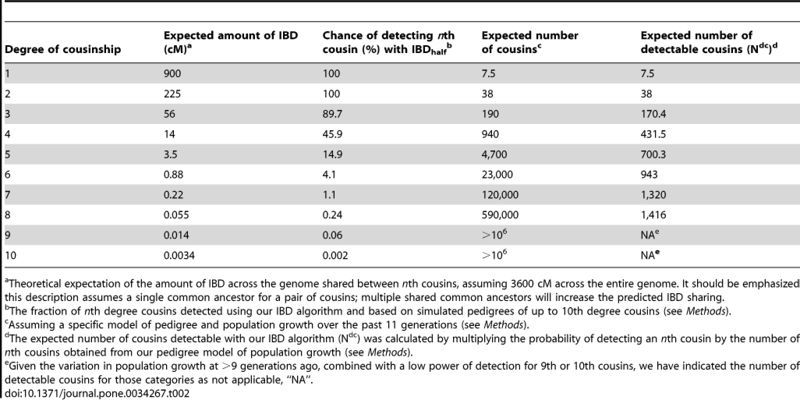
      What we often hear from the testing companies, is 3rd cousin this, 4th cousin that, but the reality of our matches is different. We can visit http://isogg.org/wiki/Cousin_statistics to see, that even with conservative cousin count estimate, we are likely to have more 8th genetic cousins than 7th genetic cousins that 6th genetic cousins and so forth.


    What this means for us, genetic genealogists? If we want to find common ancestors with our matches, we need to actually work on our trees! And firmly deep at that. 8th cousins are at the 7 great grandparents level, meaning we have 512 of these ancestors, which amounts to 1022 ancestors including all previous generations from parents up.

    For two genetic genealogist, to be able to compare their most likely type of cousin, 8th cousin - they would both need to have 1022 correct ancestors in their trees and compare them.
    This goal is probably not feasible in the Czech republic, due to typical time where records fail to be available (end of 17th century). Still I want to be able to track my progress of this goal, and blog seems like a perfect medium.

    Let's do this from the perspective of my grandparents first, and then one for me. I wrote a script that pulls this analysis out of GEDCOM, it is not perfect, but being a single ancestor off here and there won't make or break this statistics.

    Maternal Grandmother Anežka Kočíbová, 1935, gedmatch ID# M789839
    gen#rel~DoBmatch#anc/gen#idd/gen%idd/gen#anc#idd%idd
    1p190722100.00%22100.00%
    2gp18731C44100.00%66100.00%
    3Ggp18382C88100.00%1414100.00%
    4GGgp18063C161593.75%302996.67%
    53Ggp17784C323093.75%625995.16%
    64Ggp05C644875.00%12610784.92%
    75Ggp6C1281612.50%25412348.43%
    86Ggp7C25641.56%51012724.90%
    97Ggp8C51210.20%102212812.52%

    Maternal Grandfather Jan Musil, 1927, gedmatch ID# M396921
    gen#rel~DoBmatch#anc/gen#idd/gen%idd/gen#anc#idd%idd
    1p189922100.00%22100.00%
    2gp18601C44100.00%66100.00%
    3Ggp18292C88100.00%1414100.00%
    4GGgp17993C1616100.00%3030100.00%
    53Ggp17674C3232100.00%6262100.00%
    64Ggp5C643453.13%1269676.19%
    75Ggp6C1283527.34%25413151.57%
    86Ggp7C256238.98%51015430.20%
    97Ggp8C512254.88%102217917.51%

    Paternal Grandmother Irena Moravcová, 1932, gedmatch ID# M425590
    gen#rel~DoBmatch#anc/gen#idd/gen%idd/gen#anc#idd%idd
    1p22100.00%22100.00%
    2gp1C44100.00%66100.00%
    3Ggp2C88100.00%1414100.00%
    4GGgp3C161168.75%302583.33%
    53Ggp4C321856.25%624369.35%
    64Ggp5C642742.19%1267055.56%
    75Ggp6C1281511.72%2548533.46%
    86Ggp7C25672.73%5109218.04%
    97Ggp8C51261.17%1022989.59%

    Paternal Grandfather Emil Krchák, 1930, no autosomal data
    gen#rel~DoBmatch#anc/gen#idd/gen%idd/gen#anc#idd%idd
    1p22100.00%22100.00%
    2gp1C44100.00%66100.00%
    3Ggp2C88100.00%1414100.00%
    4GGgp3C161487.50%302893.33%
    53Ggp4C322578.13%625385.48%
    64Ggp5C642539.06%1267861.90%
    75Ggp6C12832.34%2548131.89%
    86Ggp7C25600.00%5108115.88%
    97Ggp8C51200.00%1022817.93%

    Now it is clear, there is a lot of work to be done, and it is even very visible, where I should start (my paternal grandfather).


    Overall, myself, gedmatch ID# M240291 (PM240291M1, PM240291P1)
    gen#rel~DoBmatch#anc/gen#idd/gen%idd/gen#anc#idd%idd
    1p196022100.00%22100.00%
    2gp19311C44100.00%66100.00%
    3Ggp2C88100.00%1414100.00%
    4GGgp3C1616100.00%3030100.00%
    53Ggp4C3232100.00%6262100.00%
    64Ggp5C645687.50%12611893.65%
    75Ggp6C12810481.25%25422287.40%
    86Ggp7C25613552.73%51035770.00%
    97Ggp8C5125911.52%102241640.70%
    Now having over 50% of 6xgreat grandparents is not terrible, but I am positive much more coverage is achievable.


    I will try to publish the progress as it makes sense (few times a year) and we'll see how some improvements of my tree help with the genetic genealogy research :)

    Thanks for reading!
    Kuba


    P.S. This effort, GEDCOM script and this blog were originally inspired by 2015 blog wave on this topic, including http://thegeneticgenealogist.com/2015/08/11/how-much-of-your-family-tree-do-you-know-and-why-does-that-matter.